

The instinct to brake and grip the wheel blocks the crucial ability to alert others.
HANDS standardizes the emergency warning system across all vehicles. It eliminates the distraction of searching for a button (especially in new or rental cars) by leveraging the driver's natural, instinctive reaction.
The system is activated by firmly pressing the steering wheel at the designated 10 and 2 o'clock positions. Once the danger has passed, the driver can deactivate the lights using the vehicle's normal hazard button, calmly and safely.
By standardizing the activation and making it instantaneous, every driver who uses HANDS gives the driver behind them 3-4 extra seconds of warning. That following car can then pass those seconds to the car behind *it*, rapidly accumulating precious reaction time along the highway, effectively saving lives down the chain.
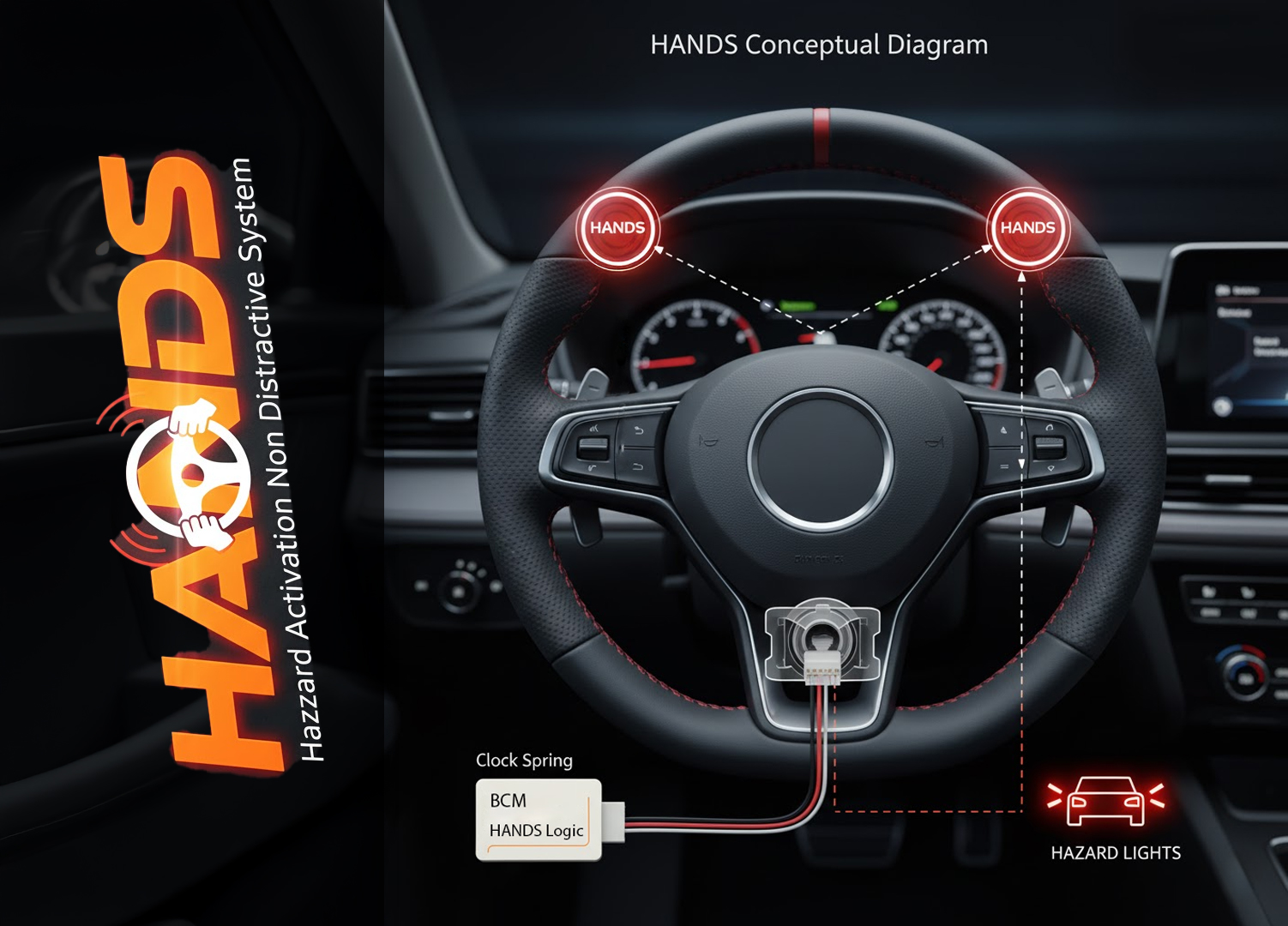 Diagram showing 10 & 2 activation points and
electrical integration concept.
Diagram showing 10 & 2 activation points and
electrical integration concept.
Instant Activation
Uses instinctual grip force to activate lights.Non-Distractive
Eyes stay on the road, hands stay on the wheel.Simple Integration
Designed to leverage existing Clock Spring electronics.Standardized Logic
Same activation logic across all car brands.HANDS is not just a concept; it's a fully documented open-source design ready for mass integration. Vehicle manufacturers already use the steering wheel's clock spring (rotary connector) to transmit control signals.
Adding HANDS functionality is simple: Incorporate a pressure point into the steering wheel design, link the resulting electrical pulse to the vehicle's system, and configure the BCM to run a latching (biestable) logic on the hazard lights.
If you are a manufacturer, feel free to use and implement this
design!
We challenge you to improve HANDS and take road safety
to the next level!
View Full Design & Schematics on GitHub
Licensed under the permissive MIT License.
This project is shared with humility and the genuine hope that, God willing, it may save lives by inspiring others to carry this idea forward.